


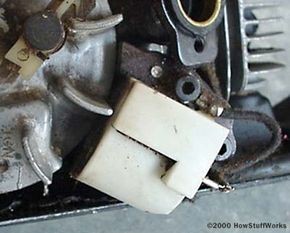
Your small engine won’t start without a spark. And that spark? It comes from a component most people ignore until it fails. The magneto.
It’s not magic. It’s physics. Specifically, electromagnetic induction.
The job is simple but brutal. You need a massive surge of electricity—between 10,000 and 20,000 volts—fired at the exact millisecond the piston reaches the top of its stroke. Do that right, and the gasoline in the combustion chamber ignites. Do it wrong, or not at all, and you have a paperweight.
The magneto is essentially an electrical generator tuned to create a periodic high-voltage pulse rather than continuous current.
Think of it as the reverse of an electromagnet. In an electromagnet, you run current through a coil to create a magnetic field. In a magneto, you do the opposite. You move a magnet past a coil of wire to create electric current. It’s a simple concept, but the execution requires precision.
This specific setup relies on five distinct parts working in unison. Ignore one, and the whole system collapses.
The Core Components
First, you have the armature. In this design, it’s shaped like a capital “U”. The two ends point directly toward the flywheel. This is the stage where the action happens.
Wrapped around one leg of that “U” is the primary coil. This isn’t delicate stuff. It’s roughly 200 turns of thick wire. Its job? To catch the initial magnetic shift and pass it along.
Then there is the secondary coil. This is where the voltage amplification occurs. It consists of about 20,000 turns of very thin wire wrapped directly around the primary coil. More turns equal higher voltage. That’s how you get from battery-level power to the 20,000 volts needed to jump the spark plug gap.
You also need a control unit. Often called “electronic ignition,” this simple circuit acts as the trigger. It decides when to break the primary current, forcing that magnetic field to collapse and induce the high-voltage spike in the secondary coil. Timing is everything here.
Finally, you have the source of the magnetism. Two strong permanent magnets are embedded in the flywheel. As the engine spins, these magnets sweep past the armature. This movement is what generates the electricity in the first place.
Why This Matters for DIY Repairs
If your engine is turning over but not firing, the issue is often here. You don’t need a degree in electrical engineering to diagnose this. You just need to check the obvious.
Are the magnets still in the flywheel? Have they cracked? Did the coil windings break from vibration?
The magneto creates the electrical charge needed to fire the spark plug. Without that surge, the spark plug is just a piece of ceramic and metal. It does nothing.
This system is robust because it’s self-contained. It doesn’t rely on your battery. It generates its own power. That’s why it’s used on everything from chainsaws to lawnmowers. Simplicity. Reliability.
But it’s not indestructible. Vibration shakes those fine wire turns. Heat ages the insulation
How the Ignition Coil Generates Spark
The magic starts when magnets fly past the U-shaped armature. They induce a magnetic field. That field pushes a small amount of current through both the primary and secondary coils. But small current isn’t enough. We need extreme voltage to jump the spark plug gap.
Here is where the timing matters. The electronic control unit watches the field in the armature closely. When it peaks, the switch opens. Just like that.
This breaks the current flow in the primary coil. The sudden stop causes a voltage spike. It’s not subtle. We are talking about perhaps 200 volts right there in the primary circuit.
Now comes the amplification. The secondary coil has 100 times more turns than the primary. This ratio does the heavy lifting. It takes that 200-volt spike and multiplies it. The result is approximately 20,000 volts.
That high-voltage pulse shoots directly to the spark plug.
Why You Need Precision Here
Most DIYers think of spark plugs as simple wear items. They aren’t just candles in a hole. They are the end point of a high-voltage chain. If your engine is misfiring, the issue might not be the plug itself. It could be the coil failing to deliver that 20,000-volt spike.
The electronic control unit is the gatekeeper. If the switch doesn’t open at the exact moment the magnetic field peaks, you lose compression. You get a weak spark. Or worse, no spark at all.
Checking Your System
You don’t need a degree in physics to diagnose this. But you do need to understand the flow.
- Inspect the Primary Circuit : Check for breaks in the wiring leading to the ignition coil. A loose connection kills the magnetic induction.
- Test the Coil Resistance : A failed coil won’t amplify the voltage. Use a multimeter to check the primary and secondary resistance against the manufacturer’s specs.
- Verify Spark Plug Gap : Even with 20,000 volts, a gap that is too wide will cause the system to fail. Too narrow, and the spark is weak.
The spark plug is just the tip of the spear. The real work happens in the coil windings and the electronic control unit. If you are rebuilding an old engine, don’t overlook the ignition system. A cheap coil can cost you more in the long run than a quality one.
It’s a high-stakes game of voltage. One weak link, and the engine doesn’t fire.


