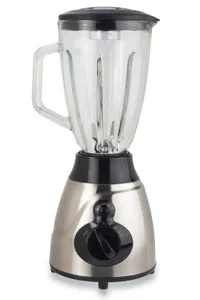
You’ll probably throw a banana and ice into a jug and press high. You get smoothies. Ready.
But take a closer look.
The machine on your counter consists of replaceable parts designed to withstand high torque. If you want to know why your dressing separates or how to fix a leak, you need to understand the mechanisms. It’s not magic. It’s engineering.
Core components
A standard blender consists of six main parts. These are the parts you may need to clean, replace or tighten:
- Case (heavy base)
– Blade assembly - Jar (jug)
- Seal (rubber sealing ring)
- Jar stand (nut holding the blade)
- Lid (with filling lid)
This is how they come together.
housing is the basis.
It’s a heavy duty, fan-cooled unit that includes an electric motor and speed controller. Weight is important.
This prevents the device from running over your granite countertop while chopping frozen fruit.
In some older or commercial models, the blade is securely screwed to the frame.
In most housings, it is modular. The blade, seal and jar base are separate parts that screw together. This design allows you to replace a dull blade or a cracked seal without having to buy a new blender.
Connection point
The blade sits in the seal. This rubber ring is important. It prevents leakage between the blade and the container.
These two fit the jar base exactly. The jar base is then screwed into a glass or plastic jar.
Now look at the bottom of the case. It has a protruding part called a connector. Manufacturers call it a clutch or serrated drive. This is the interface.
When you twist the jar onto the base, the coupler locks into the center of the blade assembly. This connects the motor to the blade. The clutch transmits the torque. It controls the rotation speed. If this part breaks, your blender will spin, but the blades won’t. All you hear is noise.
Why it blends effectively
The lid forms an airtight seal. Forget it. You will regret it.
If you mix a full batch without a lid, the pressure will increase. The content will be erupt. Clean your walls, counters and possibly your floors.
Most lids have a removable fill cap. This allows you to add ingredients such as cream or oil without interrupting the cycle. Some caps also serve as measuring cups. It’s a small convenience that saves time.
The blades themselves are made of stainless steel. They should be durable and sharp.
Most configurations use four blades arranged in multiple levels. They are set at different angles. This geometry ensures better contact with the food. A vortex is born.
The shape of the glass is also important.
Conical glasses are the most effective. Their design directs the food to the blades in the form of a funnel. Square jars leave pockets where food gets stuck. The vortex doesn’t pull it down. At the end, you get chunks.
Maintenance and safety
The blade unit is sharp. Very sharp.
Be careful when cleaning. Use a brush, not your fingers.
If your blender leaks,
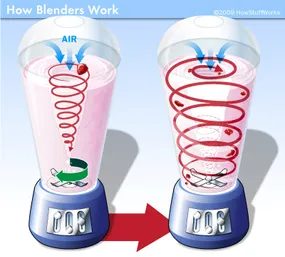
How the Blender Really Works
Think about the physics going on in that jug when you’re making a smoothie. You put a strawberry with the liquid, press the button and the motor starts. The blades rotate creating a circular vortex motion that creates a swirl in the liquid mixture. It’s not just liquid either. Even the air has its own role.
This spiral motion draws air and food toward the center, creating a vacuum. The strawberry is pulled into the middle, just like debris caught in a tornado. The difference? Everything can fit in the container of your blender.
As the strawberry breaks apart, the liquefied mixture follows the blades and creates a depression in the center of the swirl. This well is shallow. It moves the contents and pushes them towards the axis of the blade. Since there is no space under the blades, the mixture is pushed up and out the sides.
This cycle continues mixing air into the mixture. It helps to mix the ingredients faster. Turn off the Blender when you want a foamy, uniform smoothie.
Choose the Blender that suits your needs
Not all blenders are created equal. The next step is to understand what separates one unit from another. When shopping, look for specific features that suit your cooking style.
Consider motor power. A more stronger motor handles tough ingredients better. See blade design. Some blades are better for crushing ice, while others are better for pureeing fruits. The jar material matters too. Glass is heavy and durable. Plastic is lightweight and impact resistant.
Pay attention to the speed settings. Variable speeds give you more control. Pulse functions are useful for chunky textures. Preset programs can simplify the process for common tasks such as soups or smoothies.
Check the warranty. A longer warranty often means better build quality. Read the reviews to see how the Blender performs over time. Durability is key.
Think about cleaning. Some blenders are easy to rinse. Others require dismantling. Self-cleaning cycles can save time.
Size is another factor. A large jar is great for families. The compact one is suitable for smaller kitchens. Consider your storage space.
Noise level can be a problem. Some blenders are louder than others. Look for models with sound enclosures if noise bothers you.
Finally, consider your budget. High-end blenders offer more features and power. Budget models can still be enough for simple tasks. Choose the one that suits your needs and your wallet.
The right blender makes all the difference. It turns simple ingredients into complex meals. It saves time. It reduces the effort. It adds convenience.
What is most important to you? Power? Ease of use? Price? There is no single answer. The best blender is the one you actually use.