


Windows are usually the weak link in a home’s energy envelope. They let in light, sure, which saves money on bulbs. They let in heat, which helps in winter but hurts in summer. But let’s be honest: most people don’t think of their window panes as high-tech. A startup called Research Frontiers is trying to fix that mindset. They’ve patented a technology that flips a window from crystal clear to opaque in seconds. No more fumbling with blinds. Just a switch.
We’ve relied on curtains and mini-blinds for decades. They block sightlines, but they leak light. And heat. Suspended particle devices (SPD) solve that leak. Also known as light valves, these systems use microscopic, light-absorbing particles to control transmission. You can go from transparent to dark in seconds. It’s not magic. It’s physics. And it’s available for retrofitting your current glass.
How SPD Windows Actually Work
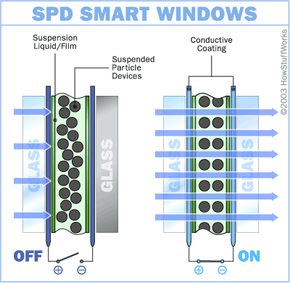
You don’t need a PhD to get the mechanics here. Think of the window as a sandwich. A Suspended Particle Device window consists of two main layers of glass or plastic. These panes are coated with a transparent conductive material. Between them lies a liquid suspension or film. Inside that fluid float millions of tiny black particles.
Here’s the sequence of events when you flip the switch:
- You apply a moderate voltage to the conductive coating.
- The electricity hits the suspended particles.
- The particles align in a straight, parallel line.
- Light flows through the gaps like water through a picket fence.
Turn the power off? The particles scatter. They return to a random, chaotic pattern. They block the light. By adjusting the voltage, you can dim the window anywhere between fully clear and fully opaque. It’s a continuum of control.
Control Options and Compatibility
You aren’t stuck with a single button on the wall. Research Frontiers offers several ways to manage the tint. Some setups use a rheostat, allowing manual dimming. Others integrate remote controls for convenience.
For the tech-heavy homeowner, you can go fully automatic. Photocells sense the sun’s intensity. Sensors detect room occupancy. The window adjusts itself without you lifting a finger.
This isn’t just theoretical. Research Frontiers holds roughly 470 patents on this tech. They license it to big players like Polaroid and GE. You see suspended particle devices everywhere now, just not always on your windows. They’re in sunroofs, rearview mirrors, ski goggles, and even flat-panel computer displays. The tech is mature. It’s just rarely in residential retrofit kits.
Retrofitting Existing Windows
The biggest hesitation for homeowners is cost. Replacing every window in a house is expensive. And disruptive. Research Frontiers addressed this with a specific patent: No. 6,429,961. It covers “Methods for Retrofitting Windows with Switchable and Non-Switchable Window Enhancements.”
This means you can upfit your existing glass. You don’t need to tear out the frames. You install the SPD film or panel over or within the existing unit. It’s a practical solution for older homes that still have single-pane or older double-pane glass.
Energy Efficiency Reality Check
Here is the question everyone asks: “If I have to use electricity to make the window clear, isn’t that inefficient?”
The math says no. Reportedly, you can power about 15 large SPD smart windows in a typical home for less electricity than a standard night-light uses. The energy draw to maintain the clear state is negligible. The energy savings from reduced cooling loads and artificial lighting more than offset that tiny draw. It pays for itself in comfort and utility bills.
The History of Light-Blocking Crystals
The tech has a weird origin story. Edwin Land, the inventor of the Polaroid camera, built the first device using SPDs. But he didn’t discover the underlying principle. A dog did.
Over a century ago, an English chemist gave his dog quinine bisulfate for an upset stomach. The dog urinated on a tray containing iodine. The chemist noticed green crystals forming in the mixture. He realized these crystals could filter light. Land later used these light-absorbing crystals to create tinted glasses. The principle remained the same. Align the particles for visibility. Scatter them for privacy.
Beyond SPDs
Suspended particle devices are powerful, but they aren’t the only game in town. You might encounter liquid crystals in some smart window applications. The technology has been around for years, powering everything from laptop screens to architectural glass. Then there are electrochromics, which perform similar functions but use a different chemical reaction to change tint density.
We’ll look at those alternatives next. But for now, the ability to switch your windows on and off offers a level of control that traditional blinds simply can’t match. You keep the view when you want it. You kill the glare when you need it. And you do it with a fraction of the energy you’d expect.
It’s not about replacing your windows. It’s about upgrading them.


