You pull the trigger. The engine roars. The chain bites into wood.
But when you let go? The engine idles. The chain sits still.
This isn’t magic. It’s a centrifugal clutch. And it’s the unsung hero keeping your chainsaw safe and functional. Without it, you’d be fighting the chain every time you tried to start a cut. Or worse, you’d stall the engine constantly.
Understanding how this simple mechanism works changes everything about how you maintain your tool. It explains why your saw feels “spongy” at low RPMs and why it locks up solid at high RPMs.
Here is the breakdown of the hardware, the physics, and why you probably never need to replace it.
The Anatomy of the Link
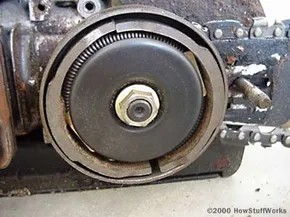
Look at the clutch drum on your saw. It’s not one solid piece. It’s a system. Three distinct parts make the whole thing move. Ignore any of them, and the tool fails.
1. The Outer Drum
This is the part you see. It spins freely around the center. Attached to it is the sprocket. When this drum turns, the chain moves. Simple. It’s the output.
2. The Center Shaft
This is locked directly to the engine’s crankshaft. If the engine turns, this shaft turns. Period. It’s the input. There is no slip here. The engine’s power goes straight into the shaft.
3. The Weights and Springs
Inside the drum, attached to that center shaft, are two cylindrical weights. A spring holds them in, pressed tight against the shaft. They don’t want to move. The spring keeps them there.
The Physics of Engagement
So how do you get the chain moving? It comes down to force. Or rather, centrifugal force.
When the engine is idling, the shaft spins slowly. The spring is stronger than the minimal centrifugal force. The weights stay tucked in. The drum does nothing. The chain stays still. This is safety. You can hold the saw, pull the trigger, and the chain doesn’t whip around because the engine is just purring.
Now, pull the throttle.
The engine speeds up. The shaft spins faster. The weights feel it. As RPMs climb, centrifugal force overcomes the spring pressure.
The weights fly outward.
They slam against the inside wall of the outer drum. Friction takes over. The weights grip the drum. Now the drum starts spinning. The sprocket turns. The chain cuts.
Once you hit full throttle, the weights are pressed hard against the drum. There is zero slip. The drum, weights, and shaft become one solid unit. The engine’s power transfers 100% to the chain.
Why Designers Love This System
Why do chainsaws, go-karts, and some mowers use this setup instead of a manual clutch like a car?
It’s automatic. No pedal. No hand lever. You just twist and go.
It slips automatically. If you hit a knot and the chain jams, the clutch slips. It prevents the engine from stalling. In a manual transmission car, you have to feather the pedal. Here? The machine does it for you.