It’s easy to romanticize the idea of drifting down a canal or sitting on a lake while sipping coffee. But the reality of living on a houseboat is a far cry from a standard apartment or suburban home. Sure, the goal is the same: you need a roof over your head, space for your clothes, and a place to store groceries. But the execution? Completely different.
Unless you are floating on a multi-million-dollar, state-of-the-art vessel, space is tight. Most common houseboats offer modest living quarters that pale in comparison to apartment-sized dwellings on land. You won’t find multiple stories. You won’t have endless walk-in closets. You have to adapt.
Understanding the Nautical Floor Plan
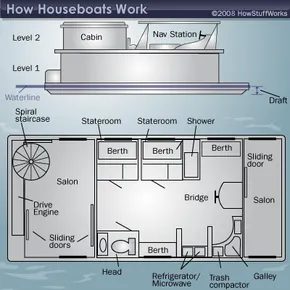
Confusion often starts with the terminology. You might be used to calling a room a “bedroom” or a “kitchen.” On a boat, those terms have specific maritime equivalents. Knowing them helps when you are looking at listings or trying to navigate your own daily routine.
- Berth: This is just a bed. If it’s located at the front (the bow) where the hull narrows into a V-shape, it’s called a V-berth.
- Stateroom: The actual bedroom.
- Galley: The kitchen.
- Head: The bathroom.
- Cabin: A general term for any enclosed space.
- Salon: The living room or main gathering area for passengers.
- Cockpit: The area where you steer the boat. Also known as the bridge.
- Helm: The specific steering station within the cockpit.
- Nav Station: The command center for navigation equipment like radios, GPS, and charts. Essential for any boat that moves.
Fixed vs. Cruising: The Utility Divide
Here is where things get technical. How does a toilet work when your house is floating? The answer depends entirely on whether your boat is fixed or cruising.
Fixed Houseboats
If your boat is stationary, it’s surprisingly similar to a land-based home. It is hooked up to a direct source of water and sewage treatment.
– Water Hookup: An external hose brings in “city water” or fresh water directly from the marina or dock.
– Sewage Line: A dedicated line sucks waste from the head (bathroom) and sends it to the shore treatment facility, just like a regular sewer line.
Cruising Houseboats
If you plan to move around the water, you cannot rely on shore power or shore sewage. You need to be self-sufficient.
– Water Tanks: You need dedicated tanks for drinking, showering, and washing.
– Holding Tanks: Waste cannot be dumped directly into the water in most places. You need a sewage holding tank.
– Heads (Toilets): These can be electric (standard RV-style flush) or manual (pump handle).
– Waste Disposal: Options vary. Some systems treat waste for legal pumping off-site. Others use macerator systems or even incinerating toilets that turn sewage into ash, which can sometimes be legally disposed of overboard depending on local regulations.
Powering the Home
Electricity is another major differentiator.
Fixed boats plug directly into marina shore power. It’s simple.
Cruising boats need their own power source.
– Generators: Common, but noisy and require fuel storage.
– Batteries: Many boaters use a split system. One battery bank starts the engine. A separate bank powers the house (lights, fridge, TV).
– Monitoring: You need amperage and voltage readers. Running water pumps, refrigeration, electric toilets, and satellite TV drains power fast.
Being stranded without electricity in the middle of a lake or ocean isn’t just an inconvenience. It’s a safety hazard. You need to know exactly how much juice you have left.
The Physics of Floating
You have the layout. You have the utilities. But the boat doesn’t sink. That requires understanding buoyancy and displacement. We will get into the physics of staying afloat in the next section.